By Danny Millum – BLDS Metadata and discovery officer
There are many fascinating rabbit holes to explore in the BLDS Legacy Collection, and you often come across them in the most unexpected places. Perhaps this just shows our limited imagination, but when we first came across a run of journals relating to different African ports and harbour authorities our hearts didn’t leap with excitement. File under “worthy but dull” and move on was definitely the first reaction to a front cover like this:
Cameroon Inter-Ports
And let’s face it, if you were asked what you thought lay within the pages of Cameroon Inter-Ports – Organe du Liaison et d’Information de l’Office National des Ports du Cameroun you would have been forgiven for thinking it would just be; tables, charts, reports and the odd institutional history. However, in order to catalogue these items we have to have a leaf through them, and when we did so we found a much richer and more idiosyncratic world than we could possibly have expected.
To start with, there was a sports section. The page below reports on a triumphant season for the Port Foot-Ball Club in 1981-82, winning the cup and coming second in the coastal league:
‘Une saison sportive heureuse’ (a happy sporting season) – Cameroon inter-ports
They obviously took it seriously as well, as half the page seems to be taken up with references to how mediocre the team had been in the past, with the hope that this change in fortune augured well for 1982-83. (Please note this assessment is dependent on our extremely shaky French and corrections are welcome!) For those who want to find out how it all panned out next season we believe we have a complete run of the magazine! More surreal than this is the humour and poetry section:
Poésie-Poésie (poetry-poetry) and humour interports
Again, this is mostly in French, but the first gag runs something as follows:
A freighter lands for the first time in a desert island far away from the usual sea routes. The captain disembarks to do a reconnaissance. He comes upon an old man with a beard down to his knees…
‘What are you doing here?’
‘I don’t know…’
‘Why did you come to this island?’
‘To forget?’
‘To forget what?’
‘I’ve forgotten.’
It kind of feels like something may have been lost in translation here – although on the same page the poem in English about tyres is if anything, more confusing…
It soon became clear, though, that journals and content of this kind are not limited to Cameroon, and that Somalia and Tanzania could give the West Africans a run for their money.
Bandari Zatu – East African Harbours Corporation
The BLDS Legacy Collection also holds what appears to be a unique run of Bandari Zetu – Organ of the East African Harbours Corporation, a journal in Swahili and English which contains a potent mix of port news sprinkled with more creative content, including this fantastic Aesopean tale, the morals of which the BLDS team have taken as a code to live by:
Somali Ports – If you are unhappy
The East African Harbours Corporation seems to have been part of the East African Railways and Harbours Corporation – which itself turns out to have been immortalised in song by the great Roger Whittaker. Check out ‘The Good Old E A R and H’ here – https://www.youtube.com/watch?v=Qwmb6WtyEUQ.
Obviously, we’re trapped at home at the moment, and so the only follow-up research I could do for this post is online. But the very fact that there is so little information on the web relating to the institutions, and journals described above is in itself further evidence of the importance of the collection. The long runs of port authority journals that are held for both West and East Africa are crucial primary sources for anyone wanting to write, not just the ‘serious’ history of transport, trade and commerce in these regions in the post-independence decades but also, possibly even more importantly, they are goldmines of ephemeral information relating to the culture of these workplaces and the people employed there.
It’s an obvious point, but as the examples above show, these dockworkers, engineers and sailors were not just employees, but also poets, comedians and footballers.
(First posted on The University of Sussex Library staff blog April 2020)
Before the spleen of writing, editing (and re-writing and re-editing) sets in, there is a fleeting moment in which the historian is like a child in a candy store, starry-eyed and gleefully lost. I experienced such a moment when, in 2016, I walked into the basement of what was then the British Library for Development Studies (BLDS) (the library attached to the Institute of Development Studies). As a historian of 20th-century West Africa, I couldn’t believe my eyes: not only was I facing an astounding collection of postcolonial government publications and academic journals from the continent, but it was all laid out in front of me on open shelves. Each shelve shone, the dust sparkled with possibilities.
During my time as temporary lecturer at Sussex, I made extensive use of the Library. With the encouragement and enthusiastic collaboration of the wonderful Library staff, I brought the undergraduate students taking my postcolonial African history module to identify the primary sources on which to build their term papers. The results were exciting – and immensely varied, dealing with issues such as economic planning in Ghana, activism and protest in South Africa, and the social roots of Boko Haram. I spent my last week at Sussex frantically taking pictures of parliamentary debates, pamphlets on the Biafra war, and academic journals published by Nigerian and Ghanaian universities.
Somali women in socialist construction – 1975
Leaving aside the impact they had on my research and teaching, it is difficult to convey the importance and significance of the BLDS (currently being catalogued by University of Sussex Library staff) African collections. An important part of their value has to do with the sheer rarity of a significant part of the material. Compared with the holdings of other institutions, shaped more directly by Britain’s colonial trajectory, these collections stand out for the wealth of material from Francophone and Lusophone countries. As many of these countries remain severely under-studied in British universities, it is comforting to know that students could immerse themselves in sources from countries other than from Ghana, Nigeria, Kenya and South Africa (in my experience, some of the favourites of students approaching colonial and postcolonial African history). The systematic way in which the IDS built its collections from the 1960s led it to accumulate material on countries that remain largely absent in British repositories. Over the past few decades, several African countries have experienced a decline in their capacity to preserve historical records, the consequence of issues as diverse as conflict and lack of funding for university and institutional archives. There is a tragic irony in the fact that some records preserved in the Sussex Library would be difficult to retrieve and access in the countries that produced them. Somalia, where a protracted civil war and political instability has taken a heavy toll on the country’s institutional memory, is a case in point. I was particularly struck by the richness and diversity of the material from the Siyaad Barre era, with publications as varied as the research on camels sponsored by the Somali Academy of Sciences and Arts, pamphlets of the Supreme Revolutionary Council, and statistics of the National Banana Board.
“I have no doubts that scholars across disciplines … would also see the immense potential of these collections, and find plenty of reasons to make Sussex (alongside better known repositories, such as the National Archives at Kew, SOAS or the British Library) a key destination for scholars with an interest in postcolonial Africa.us to raise.”
However, the (ever-changing) value of all historical sources lies in the questions they allow us to raise. From this point of view, the wealth represented by these collections is difficult to convey. Firstly, these collections provide invaluable entry points into how postcolonial African states work and imagine themselves. The state occupies a central and yet contested status in our attempt to come to terms with Africa’s past. It has been depicted as either too strong or too weak, the epitome of a context-specific rationality or the triumph of excess and corruption, the inevitable evolution of precolonial and colonial structures, or the outcome of contingent factors, a developmental agent strangled by neo-colonialist forces or a criminalised and rhizomatic entity. The wide diversity in this collection allows to observe closely the multiple realms, practices and discursive formations in which the state manifests itself, and to subject it to questions and methods associated with different disciplines. Thus, these government publications can inform with the same naturalness an ethnographic study of planning and temporalities, a comparative analysis of fiscal capacity, revenue composition and public debts, a policy paper on the impact of structural adjustment policies on agriculture and child mortality, or a cultural history of ports and infrastructures.
Citazioni del presidente del CRS – Jalle Mohammed Siyaad Barre
On the other hand, it would be a mistake to impose too strict a teleology – and thus make the postcolonial nation-state the ‘natural’ successor to colonial empires. In the years of decolonization, Africans imagined many political, economic and cultural alternatives to a world of ‘Balkanised’ nation-states. If the African Union’s (formerly Organisation of African Unity) publications represent a somehow obvious point to trace the evolution of the Pan-African imagination, these collections facilitate a holistic appraisal of the forms of institutional cooperation and the networks of solidarity envisaged in Africa in the second half of the 20th century. Indeed, these collections are a precious window onto a much more complicated and fragmented ecology that includes less studied institutions like the All Africa Conference of Churches and the Pan-African Postal Union.
Nor would it be accurate to reduce discussions of ‘decolonisation’ to the quest for alternative political and economic arrangements. The political struggle was – and is – paralleled by an epistemic one – one for ways of interpreting and constructing reality informed by the specificities of African experiences and perspectives. From this point of view, this collection remains an invaluable resource to observe closely the methodological concerns, the theoretical reference points and the empirical strategies employed by African scholars and institutions. How did they change, and why? What do these changes tell us about their perception of the relevance and the political implications of Western epistemologies? How does it speak of the political context in which these contributions were conceived? How easily did they travel outside their context of inception, and what were the epistemic and practical obstacles that prevented their further dissemination? Whether one is interested in how Burkinabé scholars discussed Marx under Thomas Sankara, in what historians in 1960s Nigeria thought about oral evidence, or in South African economists’ stance on racism and oppression during apartheid, these collections stand like palm trees waiting to be tapped.
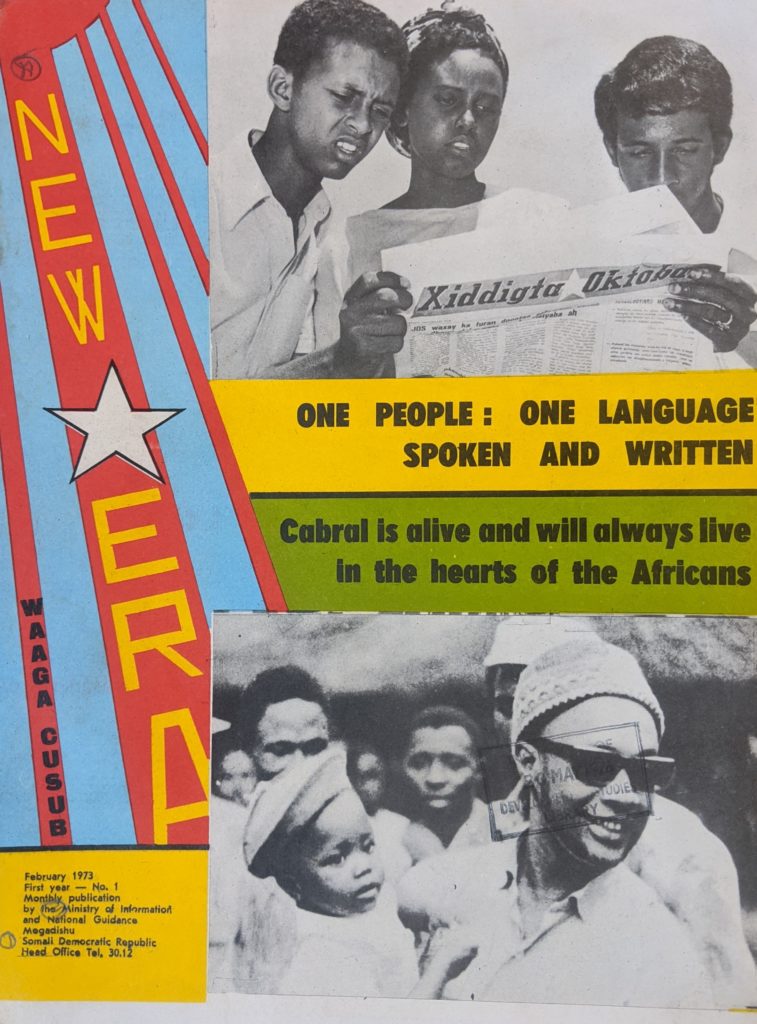
New era – Waaga cusub, Feb 1973
The list of possible questions that the holdings in the BLDS Legacy Collection could help raise and address could go on. This casual attempt to convey the importance of these collections has been inevitably conditioned by my research interests. Yet I have no doubts that scholars across disciplines interested in other issues would also see the immense potential of these collections, and find plenty of reasons to make Sussex (alongside better known repositories, such as the National Archives at Kew, SOAS or the British Library) a key destination for scholars with an interest in postcolonial Africa. On the other hand, through the preservation, digitisation and sharing of some of these records with African institutions, the Collection could become a global player committed to restoring and encouraging the continent’s institutional memory.
Gerardo Serra is Presidential fellow of Economic Cultures at the University of Manchester


 The British Library for Development Studies Legacy Collection