In May this year a really positive and inspiring workshop based on the BLDS Legacy Collection (and funded by the Sussex Higher Education Innovation Fund (HEIF)) took place. Organised by Paul Gilbert from Global Studies and Danny Millum from the Library, the event was in two parts.
The morning featured presentations from a number of researchers using the collections in their current work in the morning: Dr Gerardo Serra (Manchester), Dr Erica Nelson (IDS) and Dr Alice Corble (Sussex Library AHRC-RLUK Fellow) on their engagements with the legacy collection in their current projects.
These presentations all signposted different ways that this unique and underused collection could be of value to researchers, and are well worth checking out.
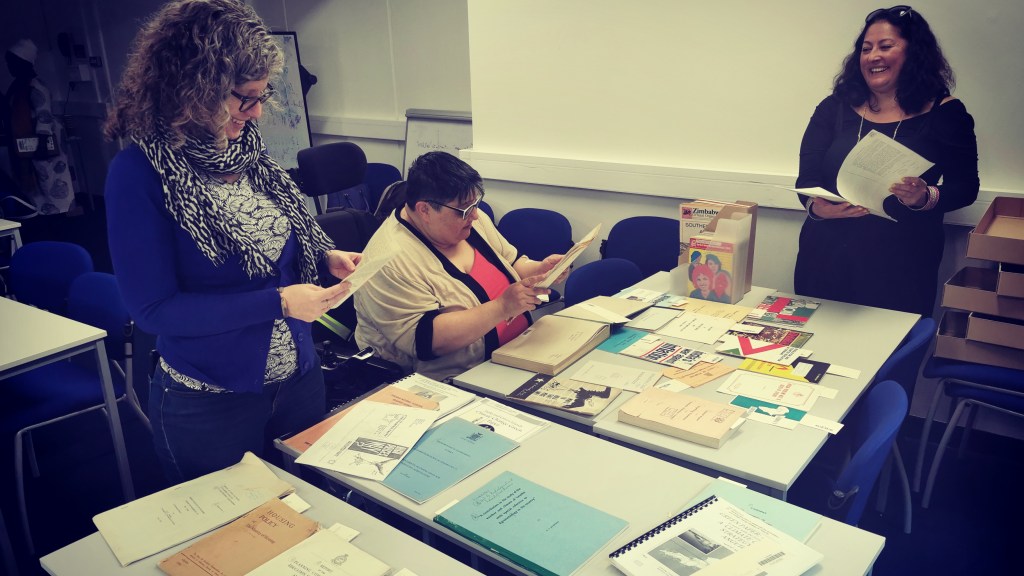
However, it was the afternoon session that was particularly fruitful. Participants had been asked in advance to pick out some items from the collection that either particularly interested them OR which appertained to their research, and as a consequence everyone in attendance had a direct interest in the materials and the discussion which followed.
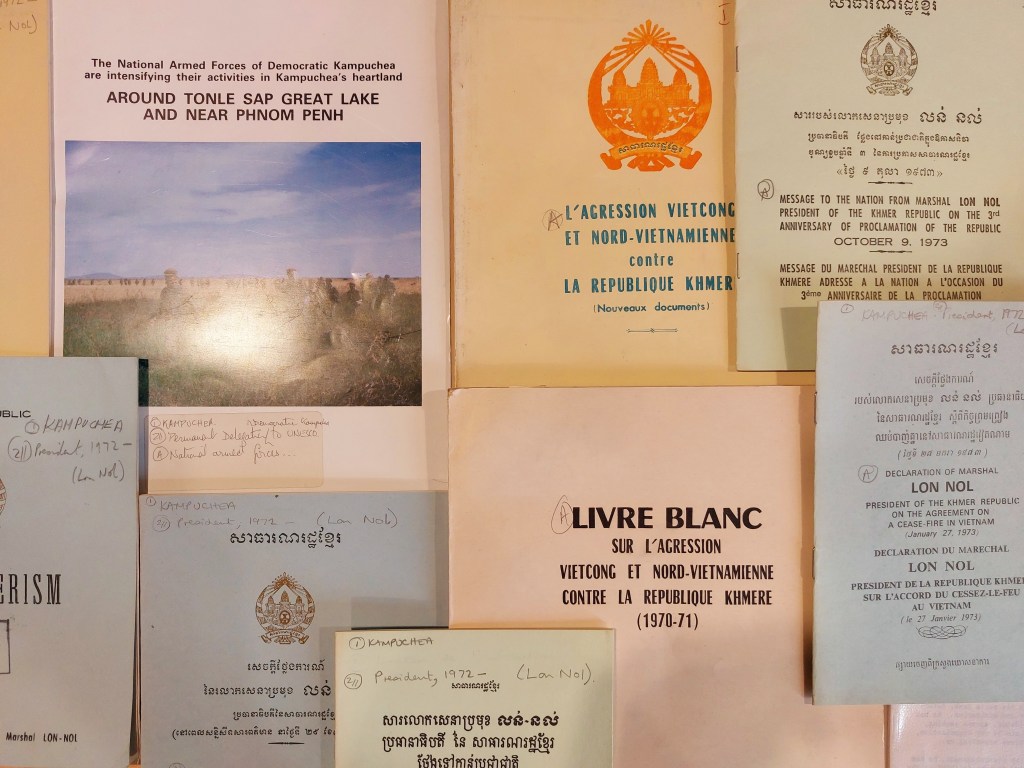
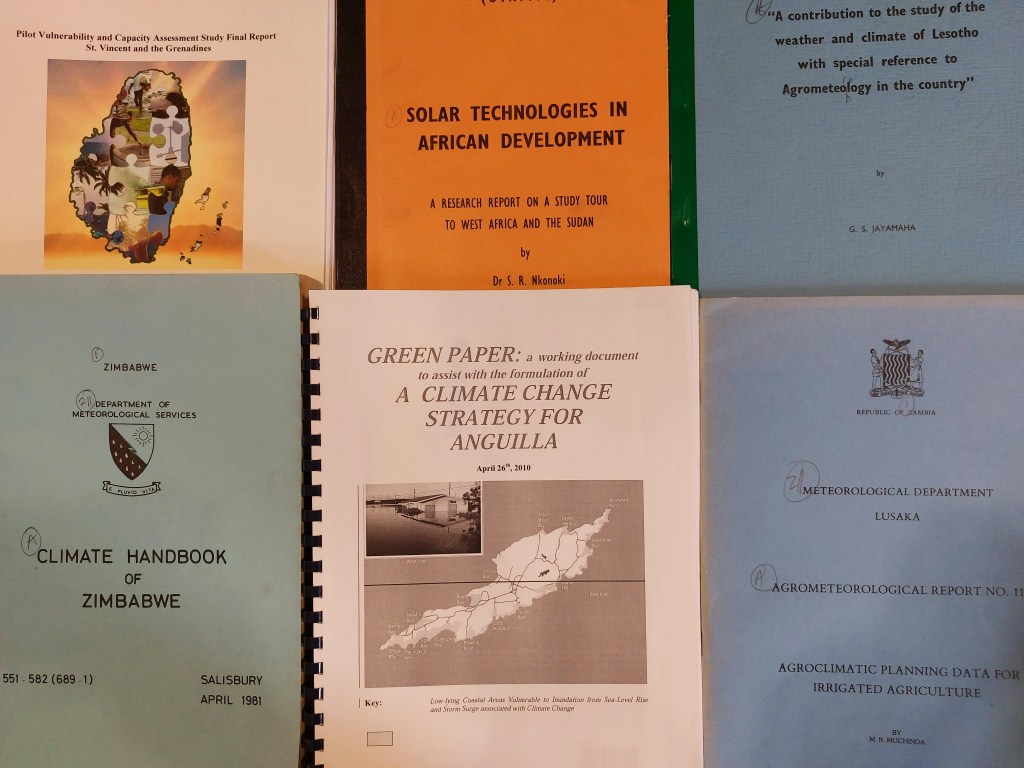
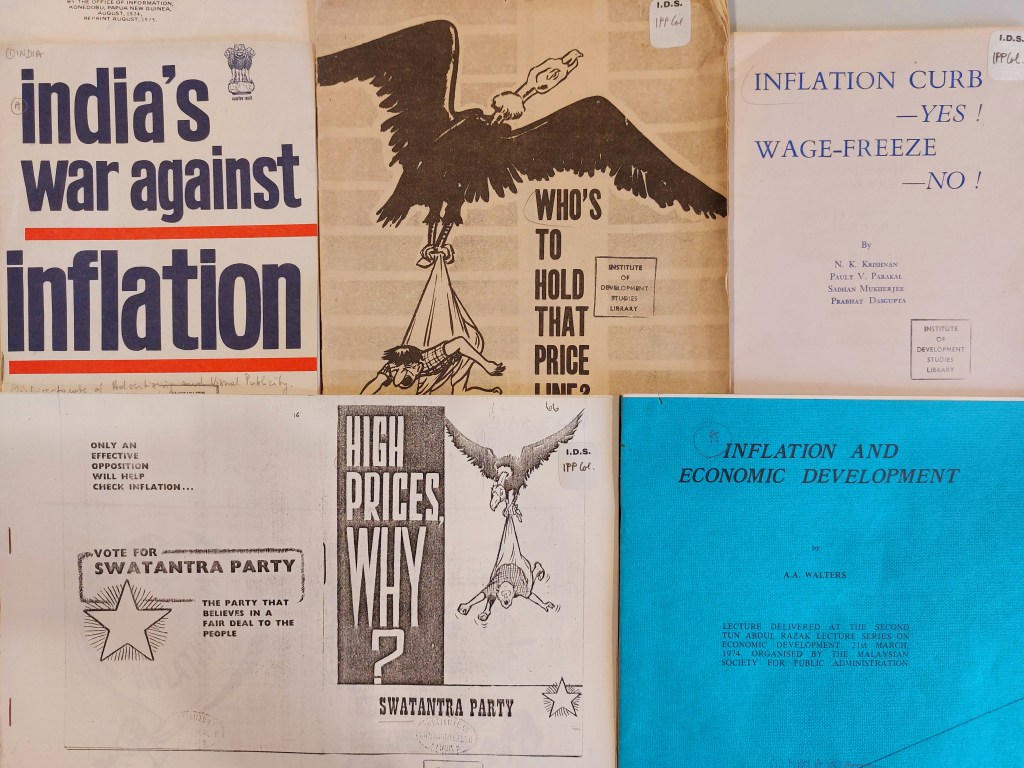
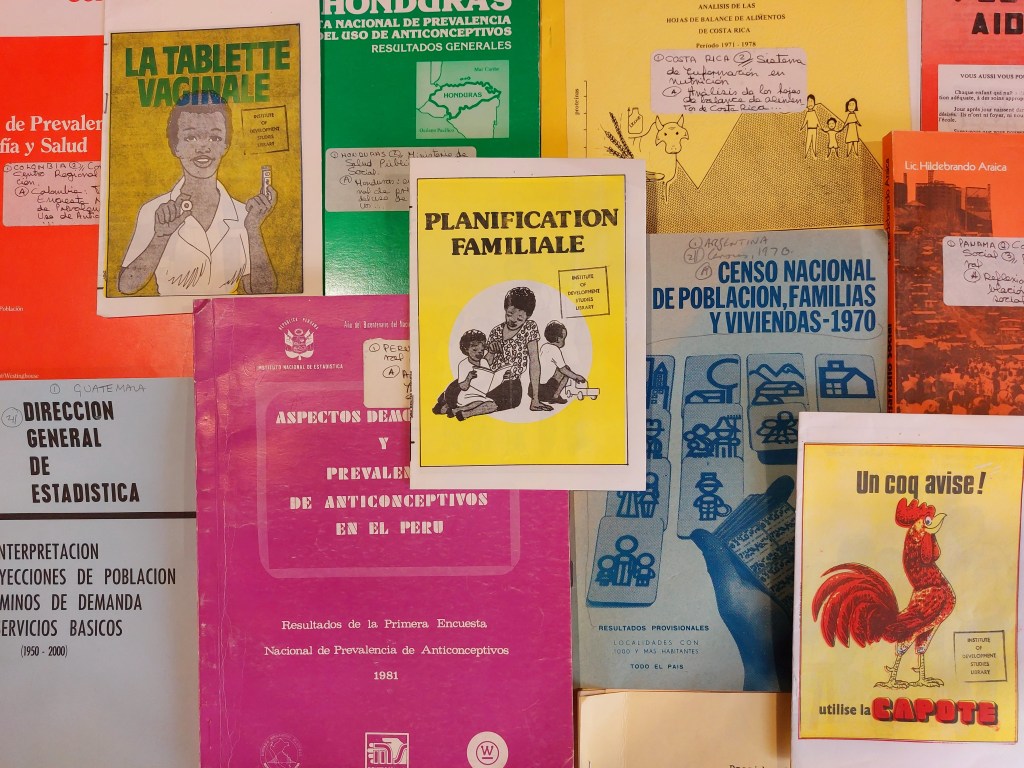
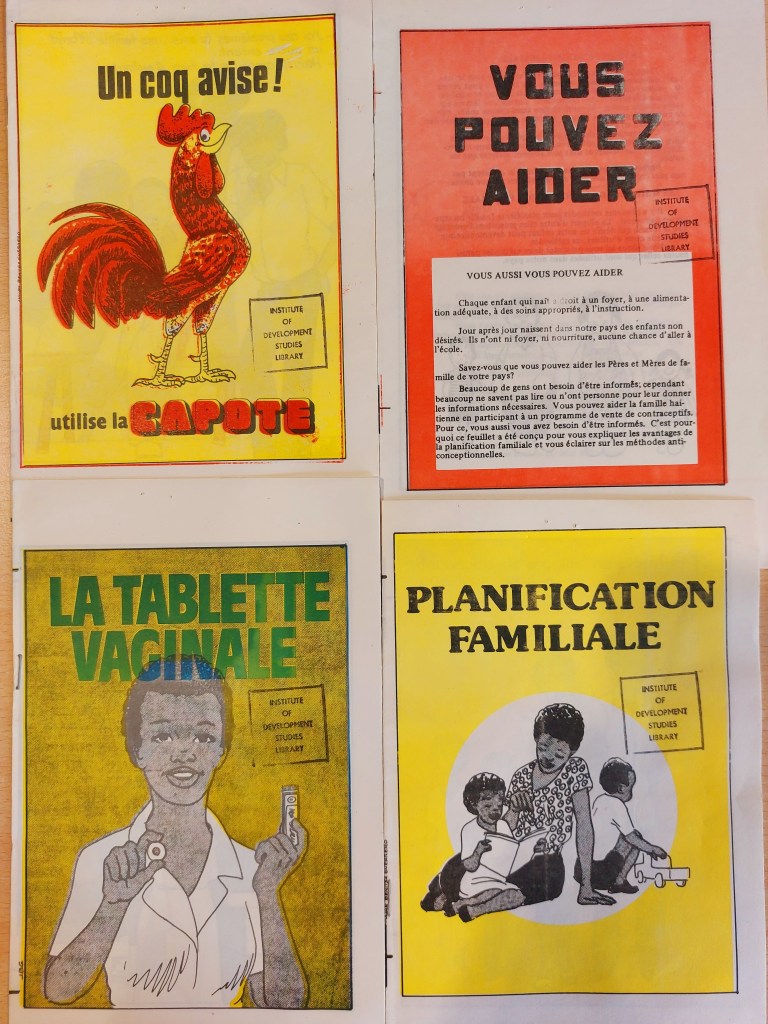
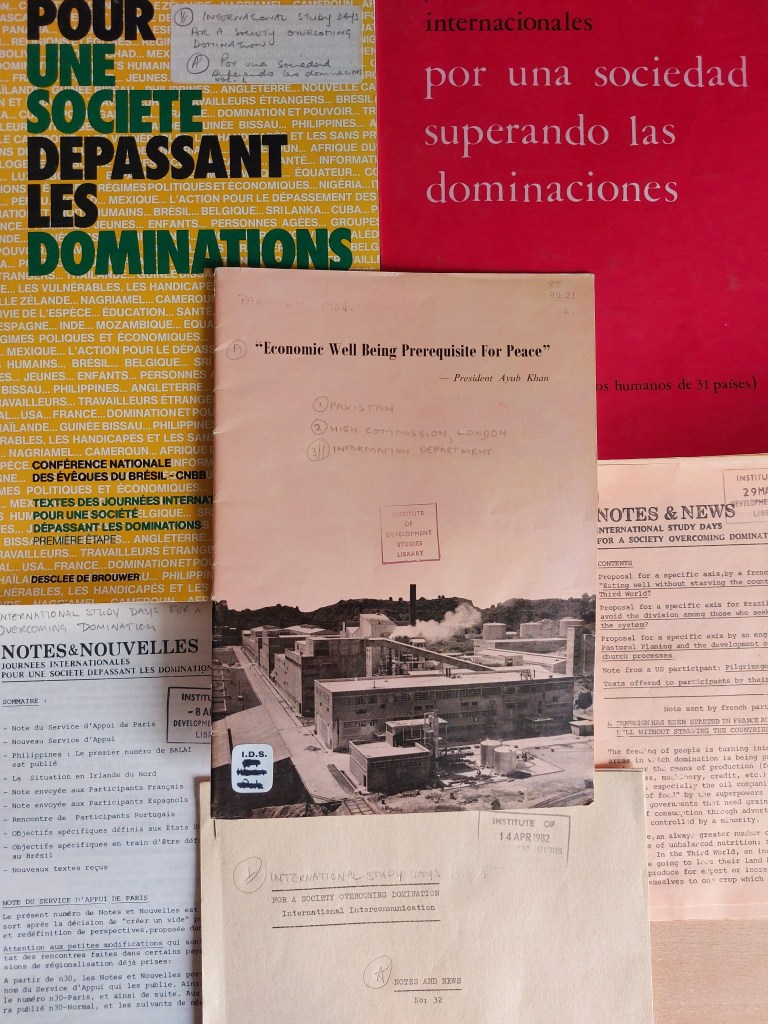
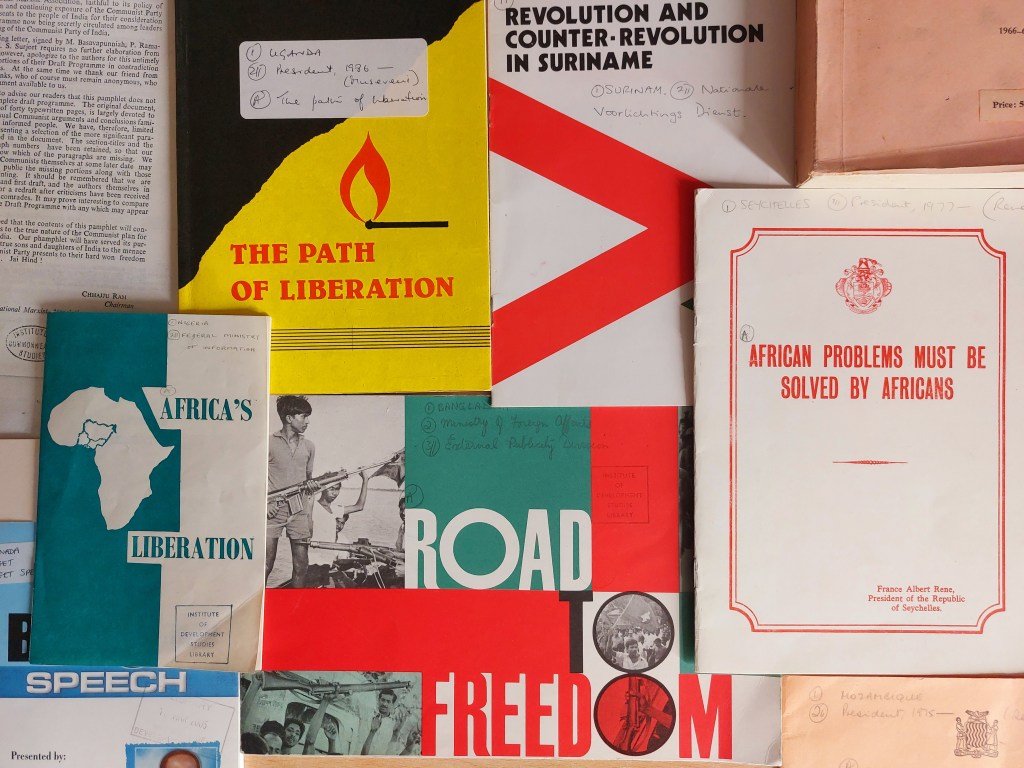
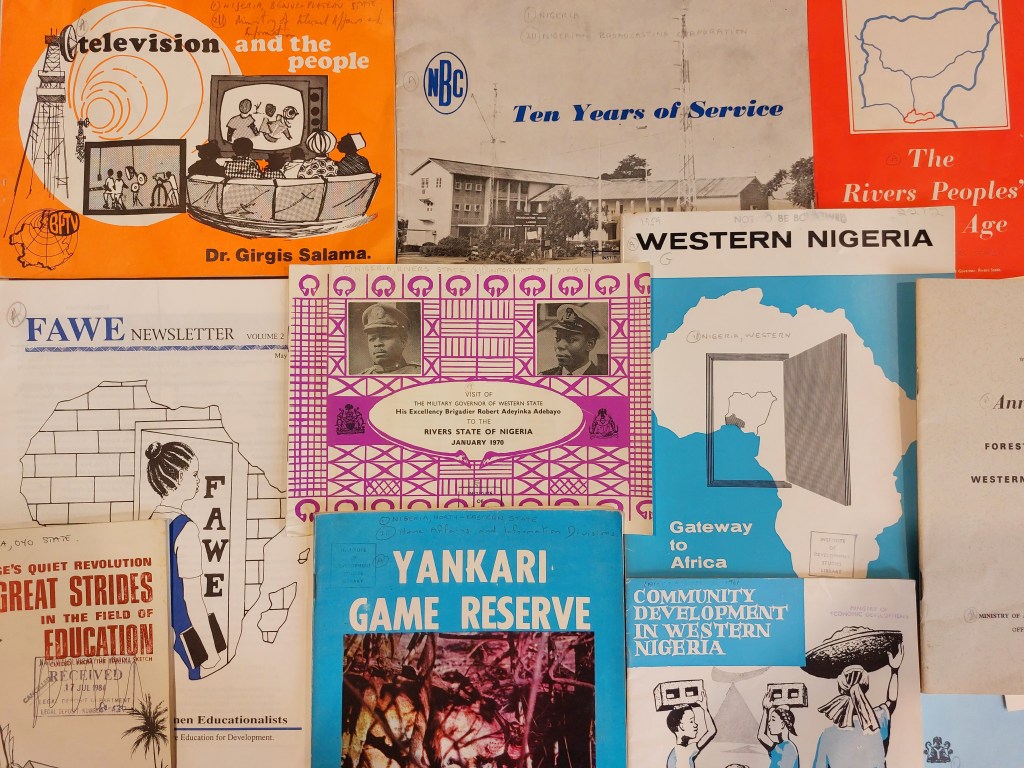
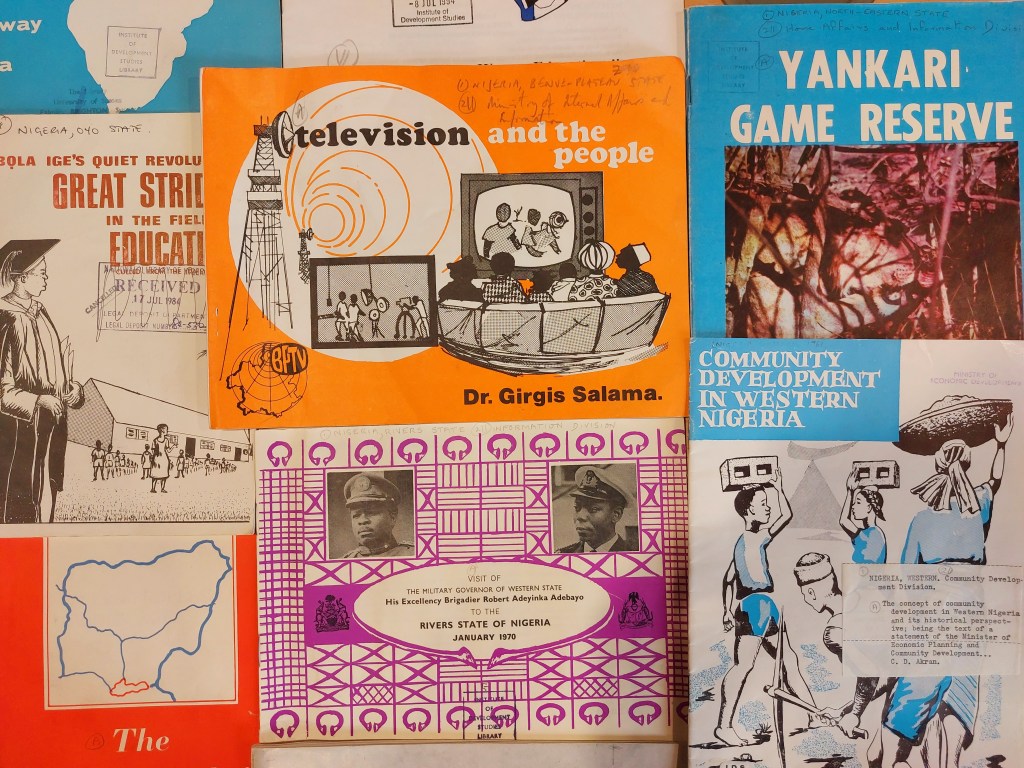
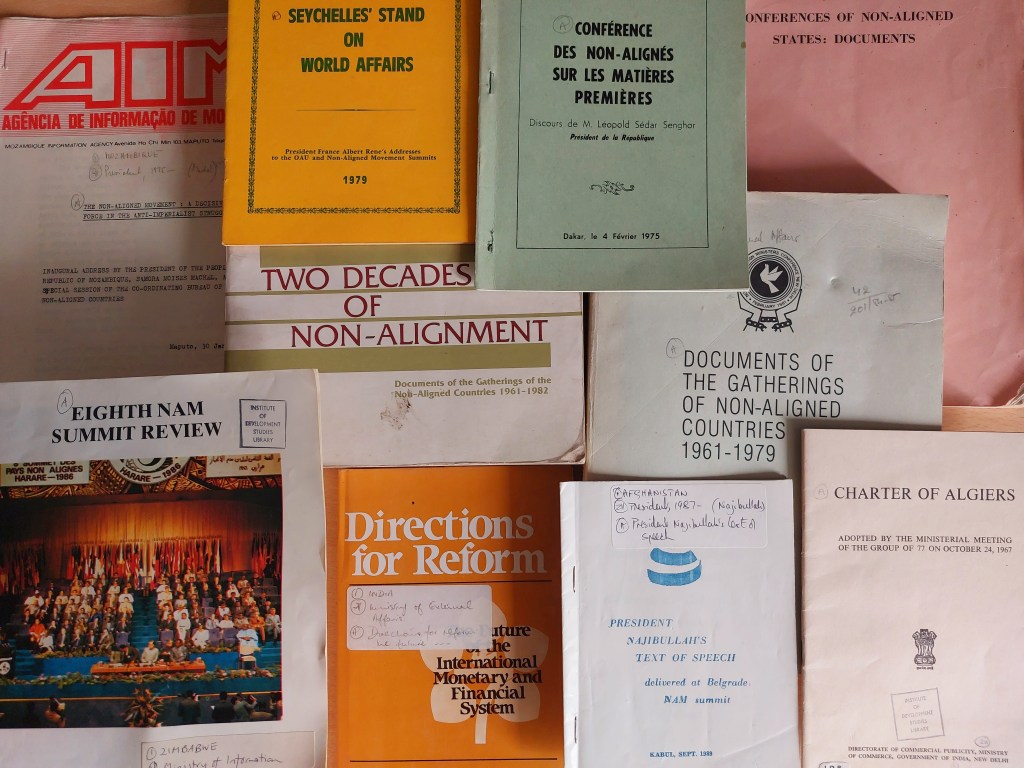
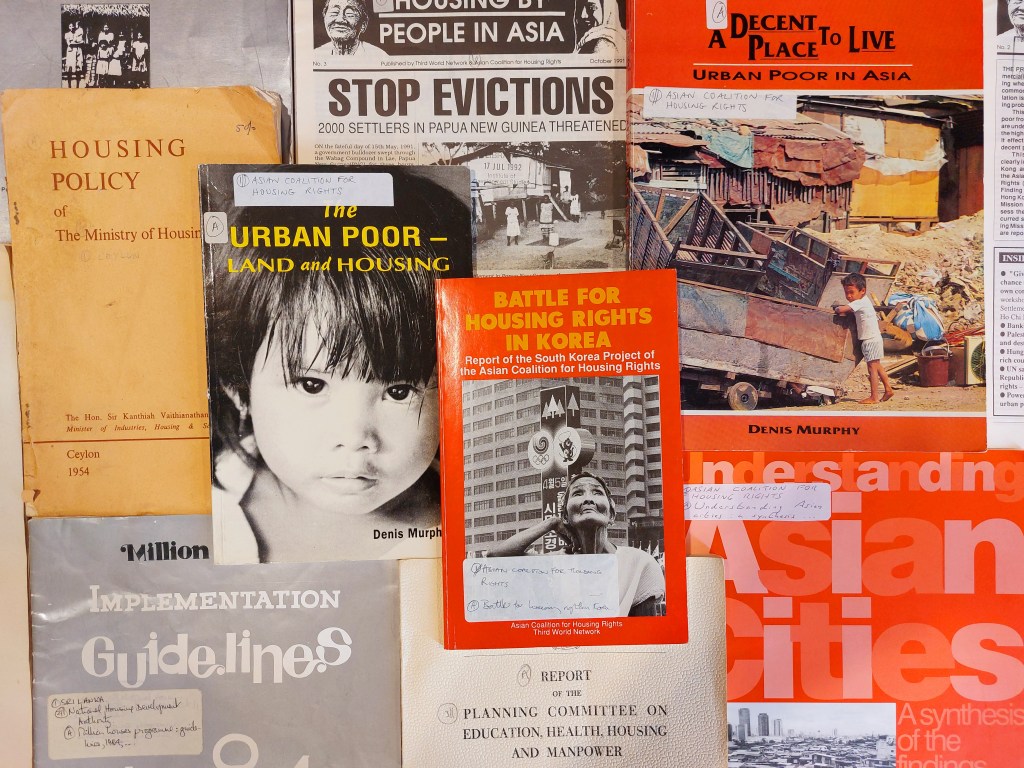
The subjects and countries covered included: Cambodia; climate; economy and inflation; family planning; liberation and resistance; Nigeria; the Non-Aligned Movement; planning and housing; and Tricontinental – and a gallery of images of the materials displayed can be found below.
CambodiaClimateEconomy and inflationFamily planningFamily planning 2Liberation and resistanceLiberation and resistance 2NigeriaNigeria 2Non-Aligned MovementPlanning and housingTricontinental
Participants discussed how we might want to engage with these in our work, how we might collaborate to explore specific features/items/stories in the collection, and what kind of questions we should be asking about the materials themselves – not to mention the question how the collection itself tells us about the history of UK involvement in international development over the second half of the twentieth century.
Then, in a big group discussion at the end of the day, we spoke about how to take things forward from this event, and how to go about engaging with this collection in a reparative or restitutive way. As a number of people mentioned, thanks in no small part to structural adjustment initiatives which actively defunded higher education institutions especially across Africa (discussed incidentally by Grieve Chelwa on this recent podcast), many of the items in the BLDS Legacy Collection are not held or easily accessible in locations that they were written or published initially. Attendees were in agreement that (a) we would like to encourage more people to know about and use the collections through our networks, but also (b) these collections should be accessible more widely, ideally online and without a paywall, for global majority students and researchers.
So, we had discussions about a ‘plan of action’.
To make our networks aware of the collections
To think about areas of interestyou think could be a priority for digitisation (given that we need funding to digitise the collection in its entirety)
To think about how we might to secure external funding to digitise the collection and make it open (no paywall/subscription)
To seek, as an important precursor to point 3 and political move in its own right, an institutional commitment from Sussex/IDS that they will support efforts to digitise and make open these collections. To this end, some of the Sussex staff present will speak to colleagues in research director and other roles
To create a collective statement on the importance of restitution/repatriation/reparative* approaches to this archive/collection, which we could then seek external signatories for to encourage the institution to make its commitment. Danny and I will liaise about a first draft of this statement to circulate to you all
We’re now in the process of putting this plan of action into effect – so watch this space and do get in touch with Paul (p.gilbert@sussex.ac.uk) or Danny (dgm24@sussex.ac.uk) with any questions!
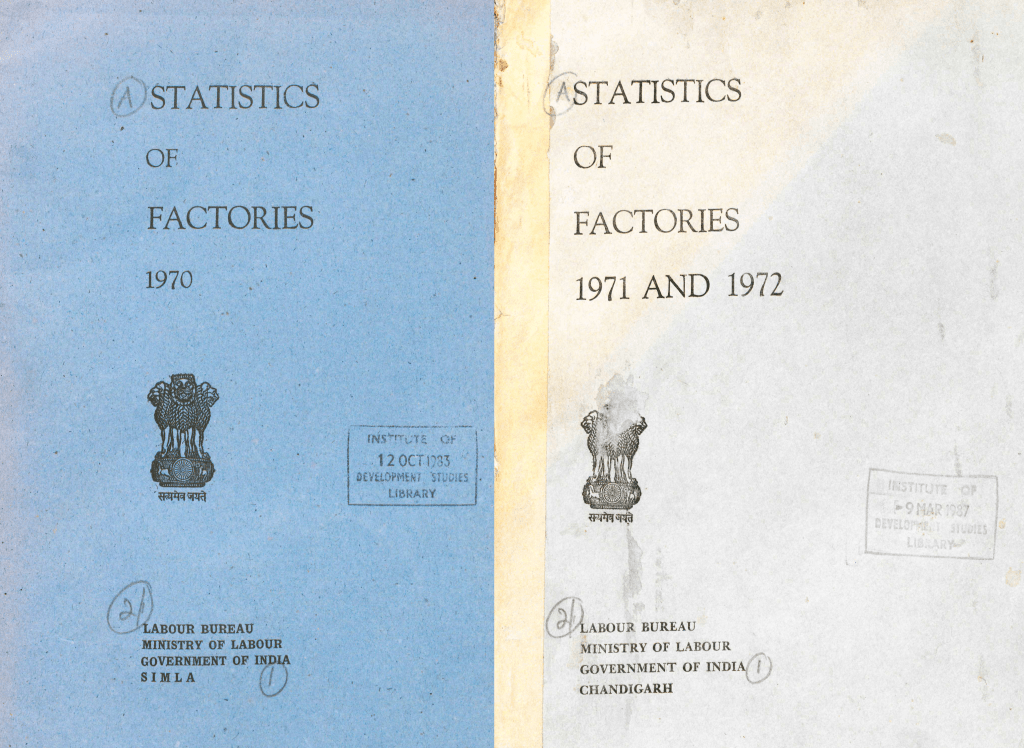
Why does the Government of India put out so many different statistical publications with uninformative names and overlapping information?! And why is none of them consistent over time in terms of what it contains?! I sound grumpy, but it’s actually been an entertaining (if exhausting!) detective chase for me over the last year or so, trying to put together a comprehensive database on occupational injuries in India over the last five decades.
Over the course of my quest, I have made a few schleps to the Bodleian library, the LSE library and the British Library, but what has really been a life-saver for me is Sussex’s BLDS collection which has somehow managed to squirrel away some of the most obscure government reports (Statistics of Factories!!!).
It’s also been an iterative process: I’ll usually think of some particular piece of data that I need and then go out to collect it, but then once I’m back at my desk with my thinking cap on, I’ll realize that I need something more besides, and then I’m back at the Sussex library the next day bugging Danny and Julie to drag some more volumes out of the collection for me. I am so glad for their good humor.
I think I can see the finish line now (famous last words!), but when (if!) it’s over, I’ll miss the thrill of opening up an ancient volume that no one has ever looked at before, and leafing through it, holding my breath and not daring to hope……
This post was kindly written for us by by Amalavoyal Chari, Professor in Economics at the University of Sussex.
There has been a secret treasure trove lurking in the basement of the Institute of Development Studies building, adjoining the University of Sussex Library – secret, until now. We are delighted to be launching publicly the British Library for Development Studies (BLDS) Legacy Collection, a fantastically rich collection of documents tracking the history of 20th century development, now accessible to researchers, students, practitioners and the public.
The Collection comprises more than a quarter of a million reports, policy documents, educational and political pamphlets assembled by IDS researchers and librarians since the 1950s, spanning key periods when many countries in Africa and Asia were embarking on post-independence trajectories and when countries in Latin America were articulating national programmes of development and ‘modernisation’. From the lead up to the United Nation’s launch of the ‘Development Decade’ in 1961, through the formation of a diverse landscape of national and international development organisations and emergence of key areas of focus, the Collection houses materials that will give new insights into ‘top-down’ and ‘bottom up’ processes of social, political and economic change.
The Collection reflects the broad span of activities that comprised development action in the second half of the 20th century– from Health and Welfare which includes topics such as wellbeing, nutrition and water and sanitation, Environment, and Agriculture and Rural Development, Economy and Trade and Industry, to Population and Government and Politics. From landmark global conferences and policy reports and statistical runs unavailable elsewhere, to the pamphlets of political parties and trade unions and educational and campaign posters, there are many gems revealing the preoccupations and discourses of their day in vivid ways. Some are currently showcased in an exhibition at IDS, with this and related events detailed further on the Collection project page.
Whilst the materials had been accumulating since IDS was founded in 1966, there had been limited opportunity to make the material accessible for research. Thanks however to a generous grant from the Wellcome Trust, a three year collaborative project and a dedicated team, this has now been made possible. University Library staff and IDS researchers have worked in partnership to rationalise, fully catalogue and preserve the collection to enable it to be fully searchable and accessible for generations of researchers. The Collection can now be searched via the University of Sussex Library catalogue which can be accessed here or alternatively via the BLDS Legacy Collection discovery pages. In addition, thanks to funding from the University of Sussex the BLDS Legacy Collection is now housed in a brand-new roller racking system by EcoSpace in a fully refurbished basement area in the Library.
Amidst current concerns to decolonise development and global health, challenging power relations and opening up to a greater diversity of knowledge and voices, these materials provide rich resources indeed. They help track the genealogies through which powerful agendas emerged – and were sometimes contested, casting vital light and offering different angles on today’s debates. Here are three (amongst many possible) examples – ones discussed further at a launch seminar on October 19th:
Population Policies, Family Planning and the ‘Modernisation’ of the ‘Third World’
As Erica Nelson writes, commonly in contemporary global health and development circles the beginning of the ‘story’ of sexual and reproductive health and rights starts with the International Conference on Population and Development in Cairo, Egypt, in 1994. This event is still considered a milestone in the articulation of rights-based approaches to sexual and reproductive health and rights and the demand for bodily autonomy, though it remains an ‘unfinished agenda’ (Sen, 2014). Within the BLDS Legacy Collection we have examples of country-specific efforts and transnational feminist movements that speak to the cross-fertilisation of the ‘Gender and Development’ and ‘Women and Development’ movements of the 80s that influenced and contributed to this ICPD moment and beyond (Kabeer, 1994).
At the same time, the Collection also reflects the deeper, and more troubling history, of early family planning initiatives funded in many cases, and in others linked discursively and politically, to a modernisation agenda that linked economic development with fertility control (Gorsky and Nelson, 2022; Carter, 2018; Hartmann 1995). This can be seen in the many materials from the late 1960s and 70s that comprise the first post-independence national and sub-national population surveys in Africa and Asia, or in the case of Latin America, reflects the wave of population surveys carried out to generate the required data for new techniques of economic and health services planning.
Central to the expansion and application of demography expertise was the desire of philanthropic funders and international organisations, in concert with national governments, to enumerate levels of fertility and the extent to which women were aware of, or used, modern contraceptive methods. In the Collection we witness a repeated visual trope, in this late 60s to mid 80s period of the threat of a ‘population explosion’, that was perceived as a key factor that could hold countries back from achieving their development aims. In parallel, the Collection also contains runs of family planning materials stretching from the late 60s through to the 90s where the intertwining of the politics of race, sexuality and gender can be further uncovered.
Climate, environmental and controversies
As Jeremy Allouche has found, another key set of debates where the BLDS Legacy Collection provides vital opportunities for historical research concern climate and environmental change and political ecology. For instance the colonial idea of desertification was popularised again at the 1977 United Nations Conference on Desertification, held after a decade of severe drought in the Sahel, and became a persistent international policy and development narrative – despite research empirically challenging the idea that desertification is taking place at the scales and with the speed which have been assumed in the Sahel (eg. Batterbury & Warren, 2001;Helldén (1991)Swift, 1996).
The Legacy Collection holds key documents from the Institut du Sahel and the Permanent Interstate Committee for Drought Control in the Sahel (CILSS), which are valuable in understanding the political and scientific narratives around the desertification of the Sahel in relation to other development issues (including population growth). One document for instance is a warning speech by Colonel Moussa Traore, the former President of the Republic of Mali during a meeting in March 1974 at the CILSS, urging the fight against the effects of drought and desertification for a new ecological balance in the Sahel. There are also many documents published by the Institut de Sahel, on issues such as food security in Niger’s Dosso region and population and development programmes in N’Djamena, Chad.
The role of these regional international organisations is little discussed in debates around the reproduction of desertification; most of the emphasis is on donors or United Nations agencies. However, the role of these regional organisations in linking scientific research to policy should not be underestimated. Their documents provide a historical baseline to understand the persistence of neo-Malthusian ideas and ecological myths, and the ways these were challenged. They also provide insights into how these narratives are being replicated and reproduced today, as in the recent Great Green Wall Initiative (GGWI).
Seeking ‘Health for All’
As Hayley MacGregor highlights, the documents in the Legacy Collection also offer fascinating windows on the approaches adopted by Ministries of Health in newly independent African states towards improving the health of their populations. For instance, government documents highlight one of the pre-occupations of the first decades of the World Health Organisation, namely controlling infectious disease through preventative technologies such as vaccination. A booklet from the Ministry of Health of Ghana (Ghana – Ministry of Health, 1971) provides steps to ‘Keep cholera out of your town and village’ through improved water, sanitation and food hygiene, signs of ‘progress’ towards better standards of living and health.
Another document from the same ministry was prepared for a trade fair in 1967, with a preface from the Director of Health Services stating that ‘The aim is to assure investors – both foreign and local – that provision exists in Ghana for the protection and promotion of the people’s health…. As “Developing Africa” is the theme of the Ghana International Trade Fair it is hoped that this brochure will assure the visitor to Ghana that the health and medical services available in the country are receiving attention in the country’s development programme’.
The institutional and workforce infrastructures to ensure curative and preventative services included a Health Education division in the Ministry of Health, which put out a ‘Health in Ghana’ series. One of these, held in the Legacy Collection, was published to commemorate the 29th anniversary of the 1948 founding of the WHO. It chose the theme ‘Immunize and save your child’s life’, an exhortation to health workers to promote vaccination. This push was very much in keeping with the movement to promote comprehensive primary health care, in association with the famous Alma Ata Declaration of 1978.
Fascinating also in this pamphlet is the detail of the childhood vaccination regimen for Ghana, which included a prominent place for smallpox vaccination. Smallpox was the first disease in 1980 ever to be declared eradicated, hailed as a success of vaccination. The waning of protection from smallpox vaccination is now thought to be contributing to the upsurge of Monkeypox, the latest zoonotic disease of international concern.
Alma Ata famously aspired to ‘Health for All by 2000’, even at the time seen as overly aspirational. By the 1980s new concerns emerged with the HIV pandemic that hit the African subcontinent hard. It marked a shift to a paradigm of ‘global’ health and the era of epidemics that moved across national boundaries in an increasingly interconnected world, requiring institutions beyond those of the nation state. The Legacy Collection holds important documents from the harsh early days of HIV/AIDS on the African continent, when anti-retroviral therapy was not available – a sentinel surveillance report from the mid 1990s from Swaziland; a 1996 government plan for home-based care for the terminally ill in Botswana; a social welfare department report assessing orphan support in Malawi; and a 1990 manual for health care workers in Zimbabwe on AIDS counselling.
Documents from the 2000s mark the shifting landscape of global response: a 2008 progress report of the national response from Botswana to the commitments of the landmark UN General Assembly Special Session on HIV/AIDS; a booklet put out in 2006 by the African Civil Society Coalition on HIV/AIDS, which points to the activism that drove the wider rights bases advocacy for treatment and services on the continent, which gradually turned HIV into a chronic disease.
In this moment of widespread reflection on Covid-19 and the devastating health, socio-economic and political implications of the first big pandemic of the twenty-first century, these documents in the Legacy Collection throw up many themes which have recurred in recent debates about infectious disease responses – the parallels between Covid vaccine supply inequity and the slow arrival of therapy for HIV in Africa come to mind, as well as echoes of the assumptions surrounding health communication in 1970s vaccination campaigns in the strategies adopted for combating vaccine ‘hesitancy’ for Covid-19. As such these documents are a prescient reminder of the need for a real shift in thinking and power in global health.
Reflecting on the past, looking ahead
As in these examples, historical sources help us reflect on how patterns and moments of disjuncture in the history of development and global health inform the challenges of the present, and might rework, or offer alternatives to contemporary narratives of progress. At a time of current global crisis, generating calls to recast development and global health, such critical reflection and debate is needed more than ever.
With this launch, an important milestone has been reached but there is a way to go. In the coming months and years we want to engage in further outreach and networking, fostering a wider community of researchers, students and practitioners across the world using and sharing what the BLDS Legacy Collection has to offer. Crucially, we want to enhance its accessibility through further digitising projects, retaining the Collection’s unique integrity and coherence by keeping it physically in one place but ensuring its availability to those unable to visit Sussex. This ongoing journey will require further partners and resources, which we are currently seeking. If you’d like to be part of the next stage of bringing these historical treasures into global health and development light, then please get in touch.
References
Institut du Sahel – BLDS Legacy – International Organisations – Box 347-348
Batterbury, S., & Warren, A. (2001). The African Sahel 25 years after the great drought: assessing progress and moving towards new agendas and approaches. Global environmental change, 11(1), 1-8.
Gorsky, M. and Nelson, E. (2022) “Historical perspectives on international policies to improve health” In, Guttman M. and Gorman M. (eds.) Before the UN Sustainable Development Goals: A Historical Companion. Oxford University Press, 2022, pp. 83-123. ISBN: 9780192848758
Hartmann, B. (1995, 2016) Reproductive Rights and Wrongs: The Global Politics of Population Control, with new prologue by author. Chicago: Haymarket Books.
Kabeer, N. (1994) Reversed Realities: Gender Hierarchies in Development Thought. London: Verso.
Today marks the 28th anniversary of South Africa’s first post-apartheid elections, now commemorated as Freedom Day. Previously, under the apartheid regime, non-whites in general had only limited voting rights, while black South Africans were unable to vote at all. The 1994 elections were the first non-racial national elections where everyone over the age of 18 from any race group was allowed to vote.
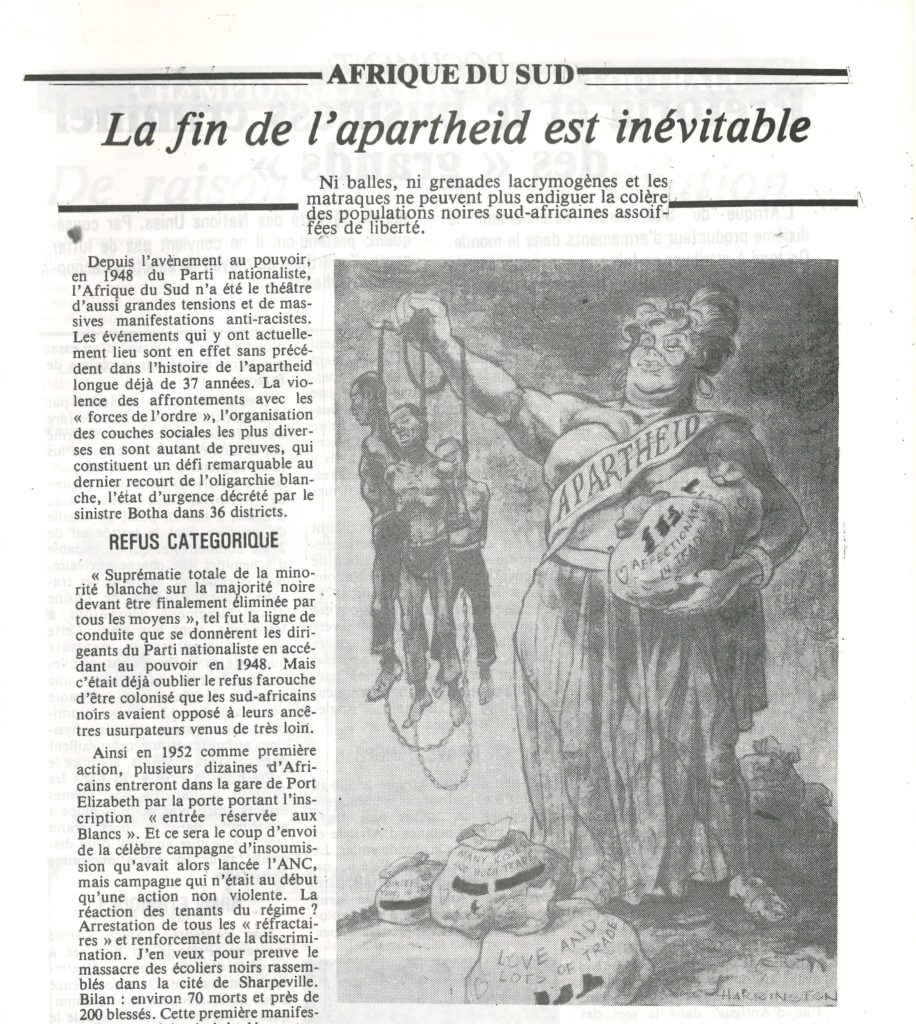
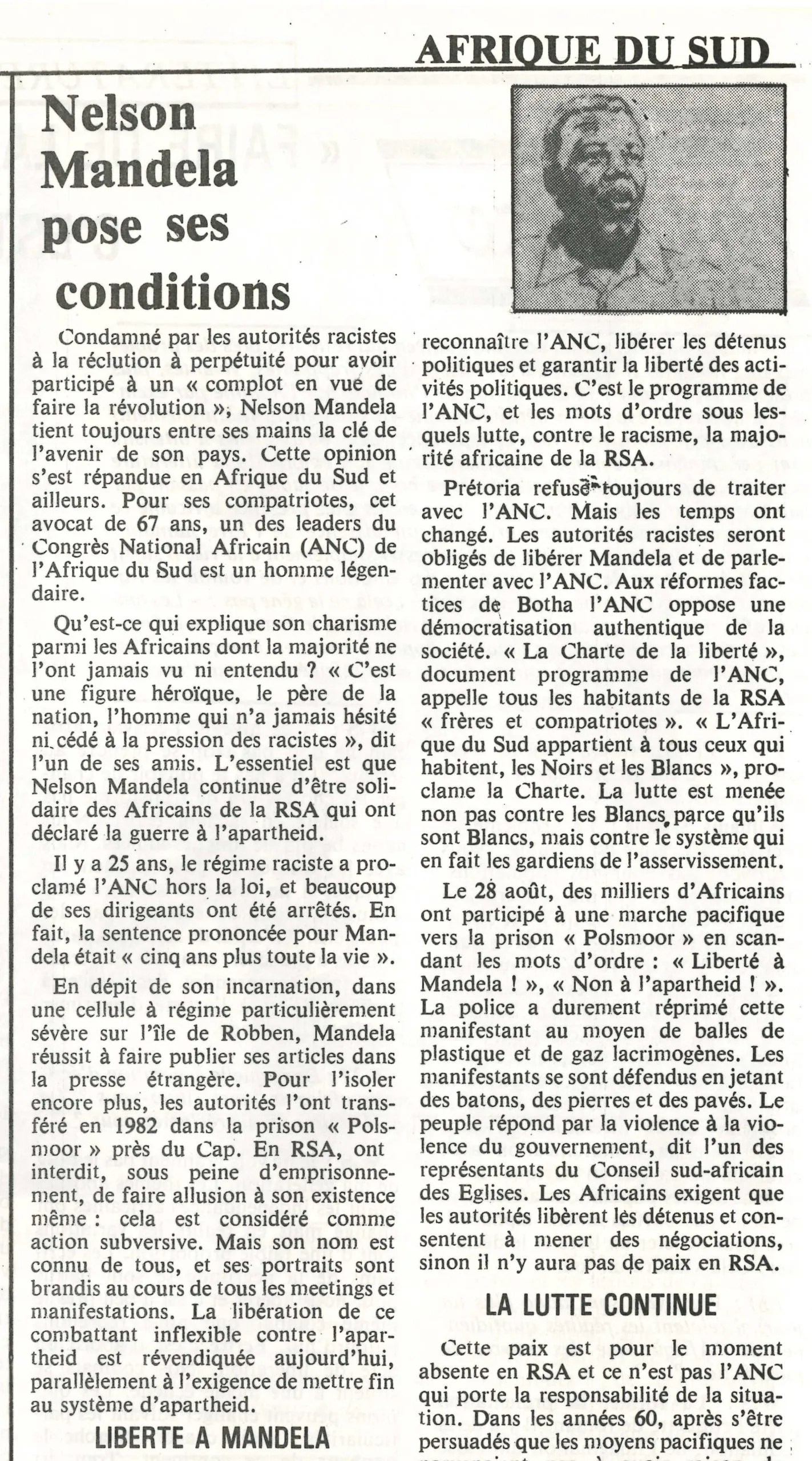
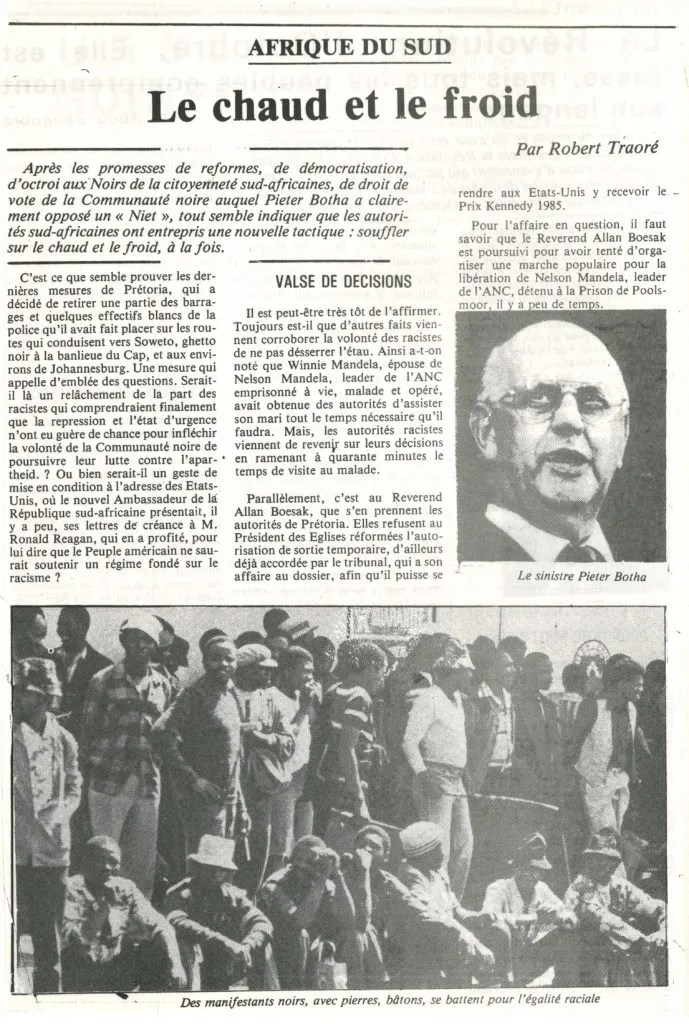
While working our way through the material from across the Global South held in the British Library for Development Studies (BLDS) Legacy Collection, it was noticeable that the issue of the apartheid regime would be addressed – in some way – in almost every country we encountered. As a consequence, we thought a blog post marking the anniversary of Freedom Day would be a great opportunity to draw attention to the multiple perspectives that the collection makes available to researchers and those interested in global reactions to events in the period from 1960-2000.
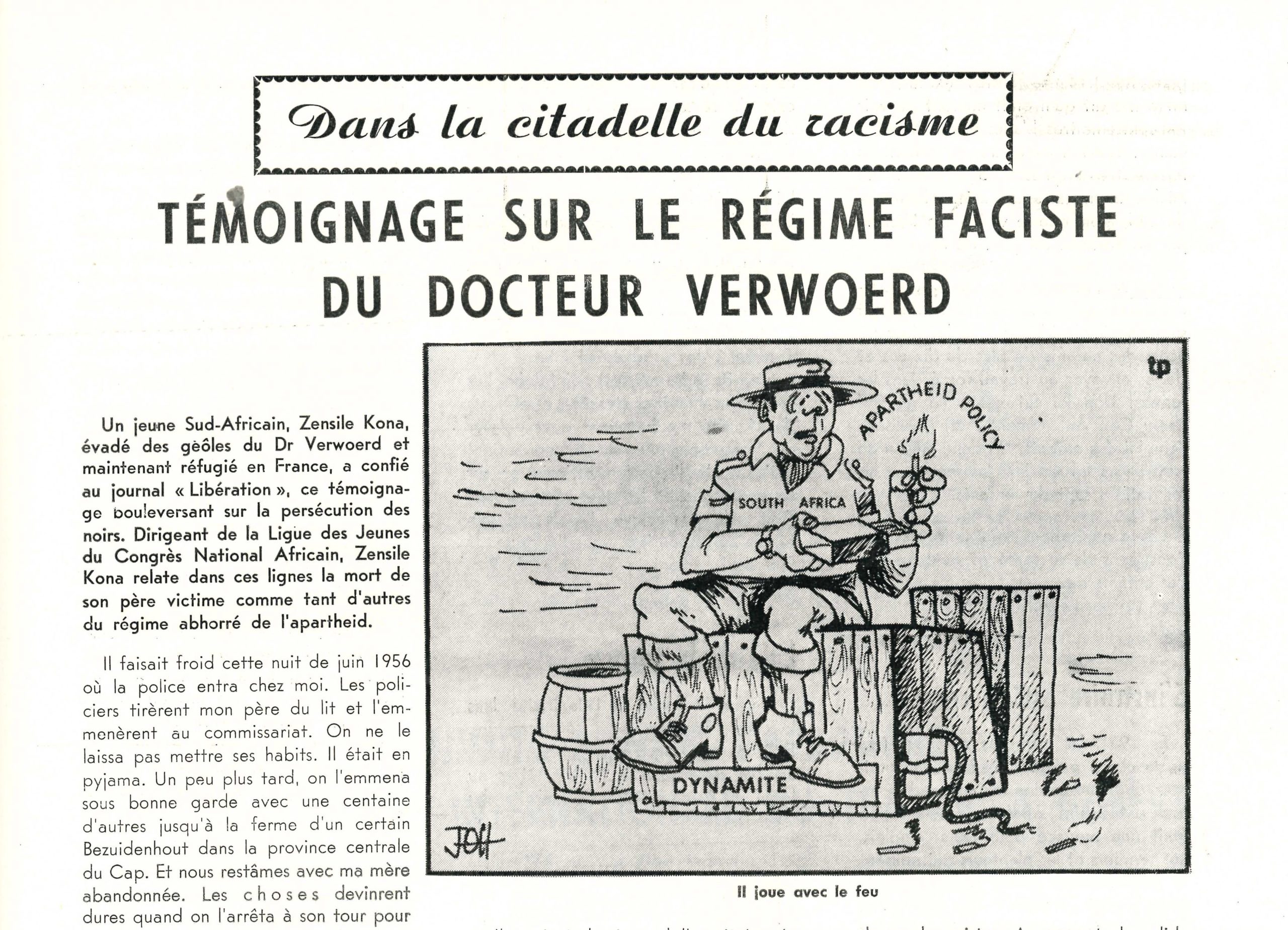
The most substantial engagement with the issue of apartheid can be found, unsurprisingly, in the material collected from other countries in Africa. The images below, found in information bulletins from Guinea and Senegal, give a snapshot of the debates around apartheid going on in these countries – the cartoons are especially striking in getting their message across.
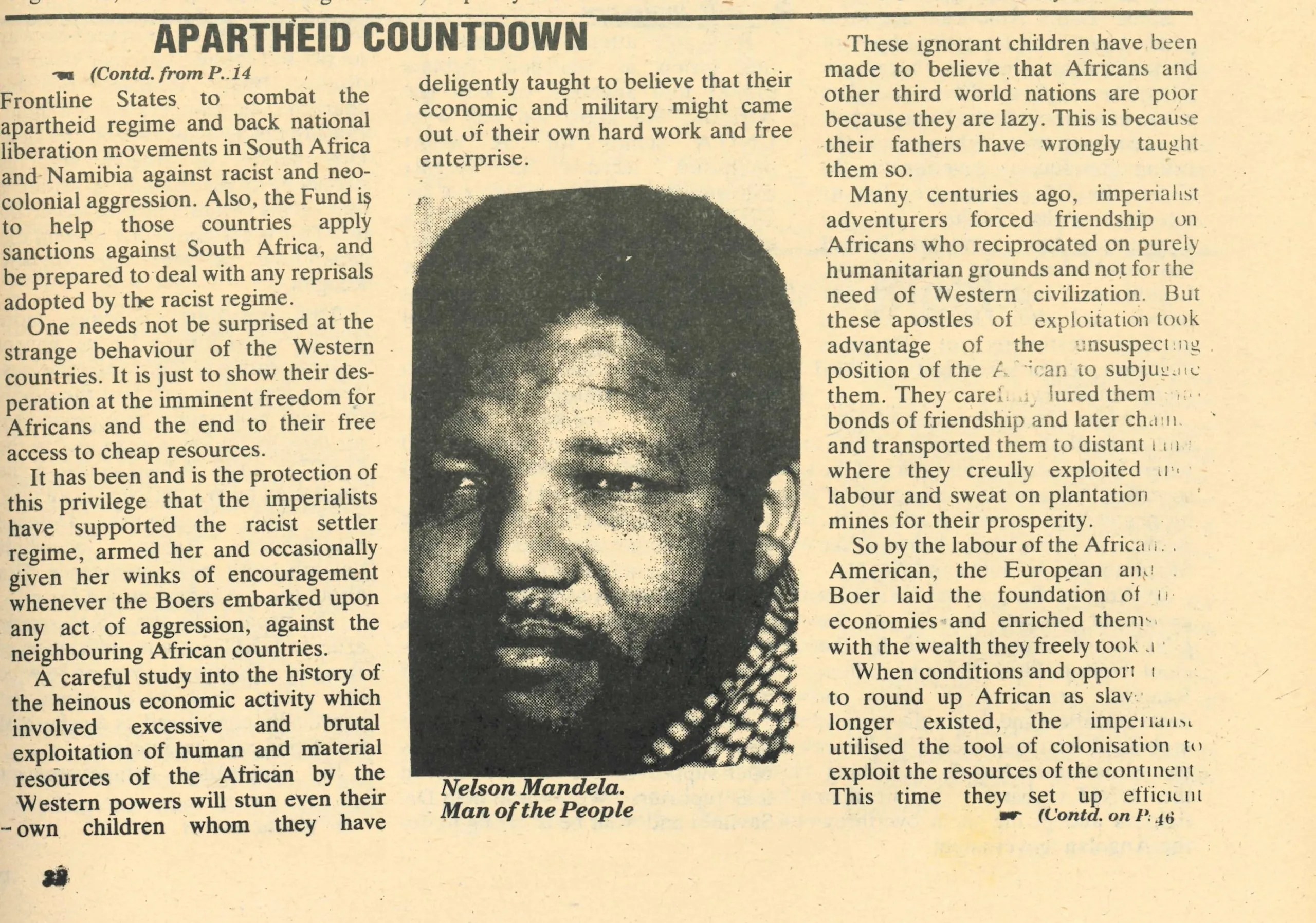
In a similar way, the pages below, from a Ghanaian journal titled The Verdict, give us some insight into how apartheid was being discussed in Ghana, but also of how the issue was situated as being part of a wider ‘liberation front’ across Africa, with the idea of solidarity across this wider liberation struggle being an important theme. It is also worth noting that the article by Pius Yaokuma-Boateng specifically names the UK and American governments of Margaret Thatcher and Ronald Reagan as ‘the two most formidable opponents’ of the struggle for emancipation for South African blacks. In this way, we can see how material from collections like these can offer new, non-Western perspectives on major global events.
The Verdict, BLDS Legacy Collection (Ghana, box 206)
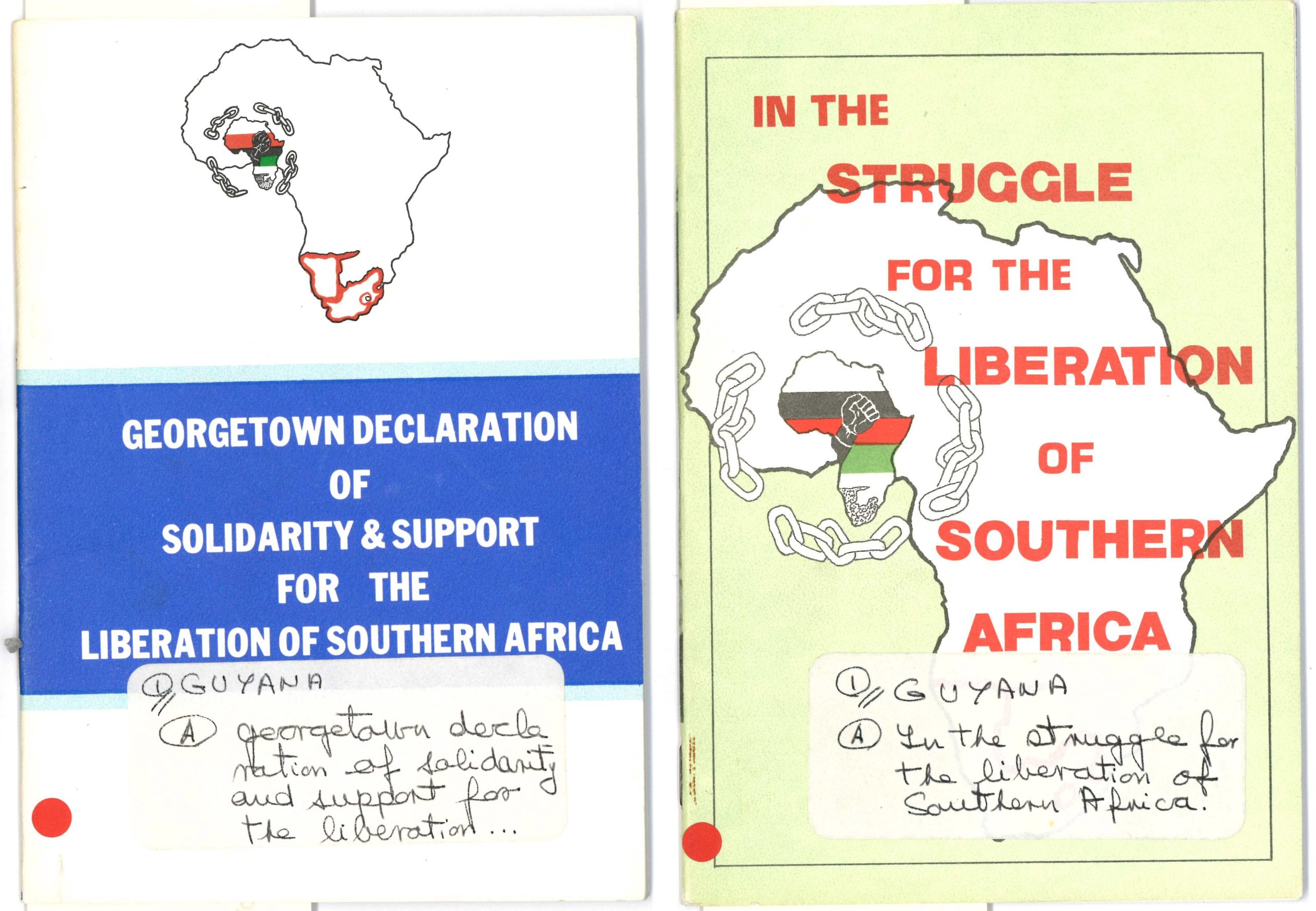
Discussion of the apartheid regime is not, however, exclusive to material from the African continent. The pamphlets below from the South American country of Guyana show how the idea of solidarity in the ‘struggle for liberation’ continues across the South Atlantic Ocean, thousands of miles away, and ties apartheid to the wider issue of Southern African liberation.
Pamphlets, BLDS Legacy Collection (Guyana, box 1)
The pamphlets mark the International Forum on the Liberation of Southern Africa that was held in Georgetown, Guyana in 1981, and give a fascinating insight into the ways in which countries from across the Global South convened to mobilise greater international support for liberatory causes.
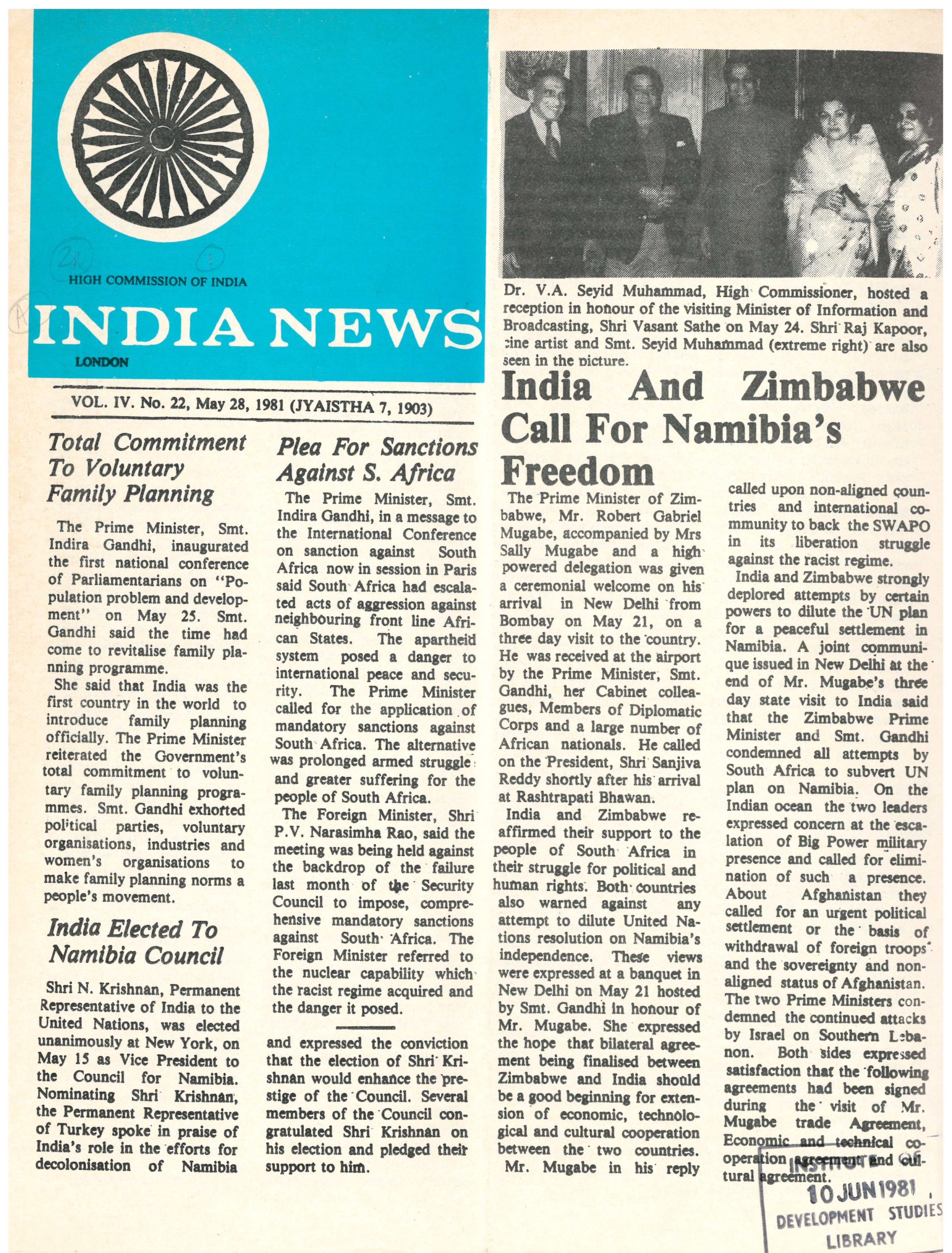
In a slightly different way, the front page from India News below, published in London, gives an indication of how prominent the issues around apartheid and potential sanctions for South Africa were at the time.
India News, BLDS Legacy Collection (India, box 1036)
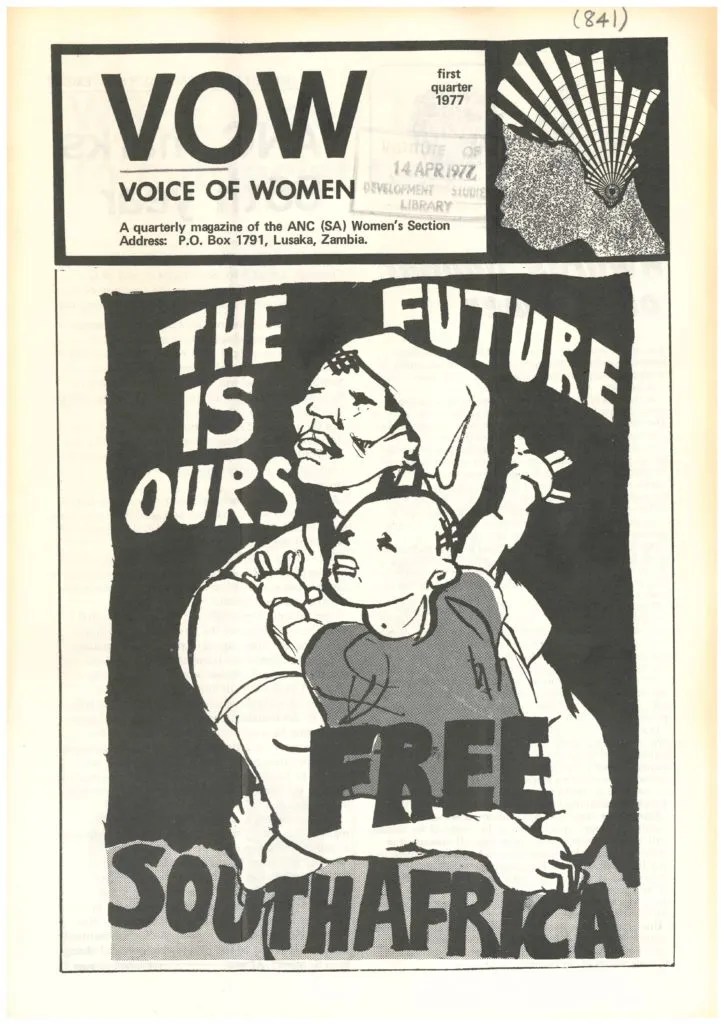
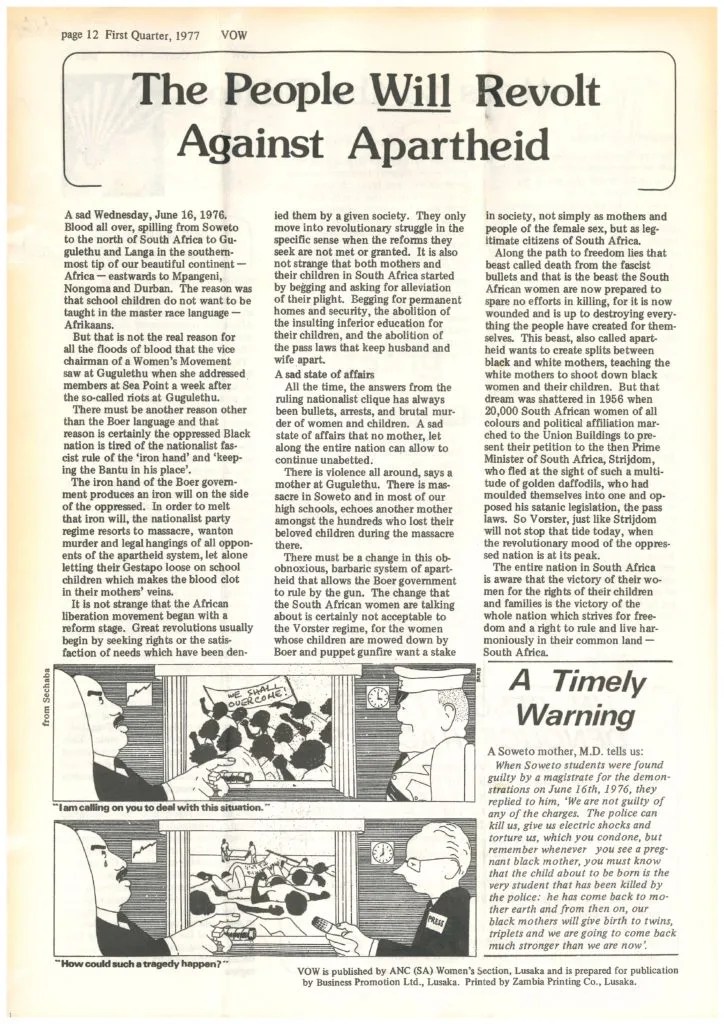
We have also included some images from a couple of the non-governmental publications we hold in the BLDS Legacy Collection. The first two images, a front and back page from the ANC-produced magazine Voice of Women are of obvious relevance here, giving a view of the apartheid regime not only from within South Africa, but specifically from the perspective of women living under the oppressive system of apartheid.
The Tedeco – BLDS – GhanaForesight prevents blindness (Health in Ghana pamphlet) – BLDS – GhanaVoice of Women, BLDS Legacy Collection
The final two images are a 1976 front cover of the Cuban magazine Tricontinental and an African bulletin produced in 1984 by the International Union of Students. These offer us another perspective again, one of international condemnation of the apartheid regime from the standpoint of anti-colonial solidarity across the non-aligned movement and the international student movement respectively.
Tricontinental, BLDS Legacy CollectionAfrican Bulletin – International Union of Students, BLDS Legacy Collection
While we haven’t had the time to dig into the material in any real depth, we hope that these examples of how the BLDS Legacy Collection’s holdings engage with the issue of apartheid give an idea of the multiple and varied perspectives the collection can offer on global events from the second half of the twentieth century.
If you are interested in learning more about any of the materials mentioned above or about the BLDS Legacy Collection in general, then please feel free to contact us at bldslegacy@sussex.ac.uk.
A brief look at the Bangladesh Liberation War through the holdings of the BLDS Legacy Collection
One of the main aims of the British Library for Development Studies Legacy Collection (BLDS) project is outreach and promotion. As part of this we are assisting with some teaching sessions at Sussex in order to demonstrate both the relevance of specific holdings and to educate and hopefully enthuse students as to the value of using primary source materials in their research.
One such class is on the International System Today course, where we will be dropping into the session on South Asia to show some materials and explain a little bit about the collection. We knew already that this area was one of BLDS’s strengths, with nearly 300 shelves of material from India, around 100 shelves from Pakistan and nearly 400 boxes from Bangladesh.
With the Indian and Bangladeshi material already catalogued (and now also available via Primo Collections) we were able to browse for material under the theme of ‘Conflict’ as well as search via the relevant Subject Headings (India-Pakistan Conflict, 1971) to find a whole host of relevant material, and then narrow this down to items containing illustrations, which we might reasonably expect to be more aesthetically appealing examples to present to students.
This was thus an opportunity to see how the metadata work we’ve done to make the BLDS Legacy Collection more accessible functions with a specific test case – and it was with relief that we realised that we hadn’t been totally wasting our time for the last two years! There was a huge amount of relevant material, and we were therefore able to pick out a few different examples for the class.
We wanted to show how material from different types of organisation can illustrate their varying agendas, and also contemporary ephemera reveals the narratives and conflicts of the time, rather than those imposed by hindsight.
So, for instance, this issue of Pakistan News, dated 15 July 1971 and produced by the Pakistani Embassy in London. The headline concerns the British response to what Pakistan considered to be Indian belligerence, with the main article reporting a formal protest lodged by the Islamabad government. Interesting too is the language used of ‘secessionists’, ‘Bangla desh’ with very much inverted commas – attempting to establish a clear narrative of illegitimate revolt and foreign interference.
We can contrast this with various publications produced by the nascent Bangladesh independence movement/government, which instead seek to turn the attention of world opinion to the atrocities committed by the Pakistani army. The Truth About Bangla Deshwhich is a compilation of press reports from foreign journalists on the March 1971 crackdown, produced by the Bangladesh Public Relations Department, and The Road to Freedom which is full of evocative photos depicting the Bangladeshis as plucky insurgents.
The truth about Bangla Desh BLDS Bangladesh – Box 389The truth about Bangla Desh
BLDS Bangladesh – Box 389 Road to freedom BLDS Bangladesh – Box 349Road to Freedom BLDS Bangladesh – Box 349
The final items in this quick survey are from the sub-collection of Indian political parties pamphlets, which provide in contrast a non-governmental slant on the conflict, and show how it fitted into wider political discourses of the day on the sub-continent.
The Indian Communist Party’s US Arms for Pakistan, final page makes clear that for the ICP, who aligned with the Soviet Union, the conflict was part of wider regional geopolitics which at the time pitted the United States, Pakistan and China against India and the Soviet Union.
US arms for Pakistan by the Indian Communist Party – BLDS India
The second pamphlet Bangla Desh and Jana Sangh is from the Sampradayikta Virodhi Committee, an anti-communalist front formed in the 1960s to combat the rise of Hindu nationalism, and shows another interesting dynamic of the conflict, namely the clash between the Islamism of West Pakistan and the secular tendencies within the Bangladeshi independence struggle – and how this complicated analysis of the struggle for those viewing it through a solely Hindu/Muslim lens.
Anti-national politics unmasked – Bangla Desh and Jana Sangh – the Sampradayikta Virodhi Committee – BLDS IndiaBangla Desh and Jana Sangh – The Sampradayikta Virodhi Committee – BLDS India
We definitely don’t pretend to be subject experts ourselves. Instead, we hope that this post highlights the value of the collection for those interested in the history of South Asia in the second half of the twentieth century. As well as illustrate the different light that the varied source material available in the BLDS Legacy Collection can shine on complicated historical events.
By Danny Millum – BLDS Metadata and Discovery Officer
Normally when you tell your family / friends about what you do, unless you’re a fireman or a nurse they just zone out (especially when your job title is Metadata Discovery Officer).
But it really seems as if the BLDS was actually my genetic destiny, as it turned out that not only was my dad interested in the project but it turns out that collecting African pamphlets runs in the family.
Buried in our loft were the following:
East African Annual 1934-35 – Tanganyika, Kenya, Uganda, Zanzibar
Zambia 1964-74 – celebrating ten years of independence
The East African Annual is just one of a set inherited from one of my great uncles, either Owen or Edward. Owen was in the Royal Navy and travelled out to New Zealand via East Africa more than once. He died when his ship was torpedoed in 1943.
Danny’s great uncle in Burma Credit: The Millum family
Those from 1947 and 1958 would be brought by Edward, who was in the Merchant Navy but served in the RAF during the war. During his time in the Navy he was memorably entertained by Vera Lynn in Burma. She apparently sang from the wing of the aircraft she’d arrived in and he got her autograph but subsequently gambled it away – certainly the picture of him hungover suggests that such dissolute behaviour (so atypical for a Millum) may not have been a one-off.
The Zambian materials are more recent – my parents taught out there in the early 1970s when the newly independent country was clearly so desperate for teachers that it was prepared to hire any old hippie that walked out of the jungle.
Danny’s parents in Zambia Credit: The Millum family
Anyway, my dad’s now threatening to donate all these boxes of material to the BLDS Legacy collection – really hope he doesn’t find much more buried in the attic or at this rate this project is never going to end…..
(First posted on The University of Sussex Library staff blog May 2020)
By Danny Millum – BLDS Metadata and Discovery Officer
One of the many consequences of the pandemic has been to accelerate the development and adoption of new teaching methods, with all the associated stress for teachers and students of having to hurriedly adapt to new approaches and new buzzwords. It’s hard to know which has been more of a headache – having to understand the difference between asynchronous rotation and blended hybrid or to listen to people complain about them.
BLDS India – Ministry of Education – Correspondence Courses USSR – 1968
So it is in fact a bit of a relief to retreat to our BLDS Legacy publications and come across a more old school approach from the late 1960s, an era of close Indo-Soviet ties and exchanges, and where the cutting edge was the humble correspondence course.
This rare pamphlet from the Indian Ministry of Education details the visit of a three-man delegation of Indian educationalists to the USSR between 30 March and April 27 1967, as the world’s second most populous nation sought inspiration in reducing its high rates of illiteracy. The reason they were looking to the Soviets was two-fold – the close relationship between the two countries during the Cold War and the apparent success of the USSR using correspondence courses to overcome their teacher shortage [1], a vital step in in eradicating literacy and one which the Indian government also needed to solve.
The delegation certainly seemed to be impressed by what they found, gushing that;
‘through this extensive campaign of adult literacy work, carried through numberless persons trained through correspondence course that illiteracy had been practically wiped out of the country in the course of two decades’
Propaganda? Almost certainly – evidence for this is that Russian correspondence material was being reported by the 1990s to be often unreadable![2] But were the Russians pulling the wool over their guests’ eyes? Or did the Indian delegation want to report the successes of socialism for their own purposes? And before we get too judgemental, examples of nauseating triumphalism – I mean ‘huge success’ [3]– are just a quick UK Department of Education Google away.
Anyway, for those sick of Zoom breakout rooms and interested in finding out more about the Soviet Zoom alternative, the BLDS team (bldslegacy@sussex.ac.uk) will be happy to answer any follow up questions. Asynchronously of course.
2. Kourotchkina, Anna & Zawacki-Richter, Olaf, (June 2012). ‘The development of distance education in the Russian Federation and the Former Soviet Union’, The international review of research in open and distance learning, Vol 13, No 3, pp. 165-184.
3. Department of Education, (March 2016). ‘DfE strategy 2015-2020 World-class education and care’, pp. 1-39.
By Caroline Marchant-Wallis – BLDS Metadata and Discovery Officer
I was chatting to my Librarian mentor recently about how we approached starting the BLDS Legacy Collection project, and I realised it was a good question. What did we do? Having been caught up in the whirlwind of the project for the past 18 months, it feels like a good time to start looking at what we have been up to.
So this is the first in what will be a series of posts over the next year or so about the BLDS project; how we have been managing it, things that have caused us sleepless nights, the highs of seeing the collection coming together, and as with most things these days some chat about how we dealt with Covid and not being able to access our collection for 6 months.
For background information on the BLDS Legacy Collection, see our previous posts here)
In the beginning…
October 2019…feelings: overwhelmed….
Walking into the IDS basement – where the BLDS Legacy Collection is housed – and seeing stack after stack after stack of densely populated shelves of material that it is your responsibility to organise, rationalise and make accessible in 3 years is a daunting prospect. One which I can’t deny did for quite a few months leave us feeling slightly panicked. To help you picture the size of the collection, when we started the project it contained roughly 4,000m of pamphlets, censuses, annual reports, monographs, journals, government publications and more.
BLDS – Shelving along wall – original material – image credit – Tracy Wilson
BLDS – Indian censuses – original condition – image credit – Tracy Wilson
BLDS Legacy Collection – Before the project – image credit: Tracy Wilson
So where did we start?
Well with a bit of good old-fashioned tidying up of the space for starters, (tidy workspace tidy librarian brain) including removing all the extraneous material and matter that had found its way into the basement over the years. A good old declutter always makes things better (although my other half dreads it when I utter that word) Then we set about trying to understand what we had become custodians of. We did this by reading through documentation created by previous librarians and IDS academics, and by physically going through the collection a shelf at a time, creating a listing of what organisations and countries were represented in the collection.
BLDS – Initial listing of material – photo credit: Caroline Marchant-Wallis
BLDS – example of listing of material in Chile
This listing had a number of purposes, firstly it helped us to know what we were working with, and secondly it ensured we were able to locate material and answer basic queries from those requiring items from the collection whilst we are working on the project.
Alongside this we were also thinking about the future preservation of the material and the physical space. We consulted with the conservator at The Keep who alleviated our fears over the condition of the material, and advised on what we could do in terms of storage. As with most projects, our budget is tight, so coming up with storage solutions that both supported and preserved the material whilst not breaking the bank was vital. We opted for pamphlet boxes, and luckily the library had a lot spare so we were able to use these for the first 300m – after that we sourced a cardboard acid-free option. I could go on and on about why pamphlet boxes instead of being straight on the shelves or closed boxes, but as I have been warned before, that might not be a very interesting topic.
Due to the location and nature of the material it was decided (in consultation with management and the project advisory board) that it would be a closed collection, making decisions regarding retrieval much easier, and also meaning we did not have to physically reorder the whole collection, which would have taken 3 years on its own. We were able instead to apply a structue on to the collection which allowed for both simple retrieval but also maintained the provenance of how the collection was originally ordered. The only exception to this was if a country had changed its name in which case we decided to move material to sit alphabetically under its current name. So for example, Ceylon changed, and moved, to Sri Lanka.
BLDS Legacy Collection – reboxed and labeled material – image credit: Tracy Wilson
Once we had a greater understanding of what we physically had and how it would be stored, we were able to start thinking about our metadata schema, subject headings and themes which we wanted to apply to the material.
The University of Sussex (UoS) catalogues using Resource Description and Access (RDA) , Machine Readable Cataloguing Standards (MARC21), and Library of Congress Subject Headings (LCSH), along with the Library of Congress classification scheme (LOC). As the collection catalogue would be hosted on the UoS Library catalogue it did not make sense to catalogue in a different way. We however needed to add in BLDS-specific information to aid discoverability. We did this in discussion with the UoS cataloguing team and decided to add in a 583 field to our schema, which would contain information on what we decided to call ‘themes’.
The collection is vast so we needed something which would help to aid thematic and longitudinal research as well as country-focused investigation. To solve this we created 19 themes, a combination of which which could be applied to each item we catalogue, with the information being entered into our bespoke 583 field.
BLDS – themes
BLDS – 583 field in MARC21
What this then allowed us to do was filter records based on theme, and create a Primo Discovery database through which users can easily search resources within a certain theme and across countries.
BLDS – Primo discovery homepage
With all of these decisions made, plus so many others which included: how to arrange skip hire (for disposals), what barcode numbering to use, pest control, and so many other tiny decisions it has been full on. With many unexpected challenges, but we are getting there, and having managed to keep on track despite Covid we pretty pleased with how things are going.
That’s a quick whistle stop tour through how we started the project and some of the decisions made. Look out for future posts on other aspects of managing the BLDS project.
By Danny Millum – BLDS metadata and discovery officer
One of the many strengths of the BLDS Legacy Collection lies in its holdings of annual reports, from both government departments and public and private companies. While obviously vital source material for business and economic historians, these might appear a little dry to others, but on closer perusal the incidental details of their production are in fact often strikingly revealing of wider social, cultural and political developments.
(Images 1-3) Air Rhodesia annual reports – BLDS Legacy Collection
One example of this which struck us during cataloguing were the runs of Air Rhodesia and Air Zimbabwe annual reports which run from 1968 to 1988/89. The fact that Zimbabwe only achieved independence relatively late gives it a unique place within our collection, as while for the majority of African countries our holdings only really begin with independence, here we have material which allows us to compare and contrast pre- and post-independence publications across a wide variety of organisations.
Just dipping our toe in the water with this one example affords us a fascinating visual insight into how the airlines saw themselves. You’d be hard-pressed to find a single black Zimbabwean in any of the images from the 1968 and 1973 issues [image 1, 2 & 3], whereas the 1981 picture is decidedly multi-racial [image 4] and by 1989 the vast majority of the office staff are black [image 5] (interestingly for much of the late 70s photographs have been replaced by cartoon images – this would probably take an entirely separate blog to explore though!)
Besides the pictures, there are also snippets of text in the reports which cast light on international political developments and their local ramifications.
As we can see from the extract below from the 1968 annual report on Traffic and Sales that the tensions between Zambia and Rhodesia following the latter’s Unilateral Declaration of Independence in 1965 were playing themselves out in the air industry as well, with Zambia banning air services between the two countries (and South Africa commensurately increasing its traffic).
“The new national airline of Rhodesia was born on the 1st September, 1967. Its birth was bedevilled by difficulties but it has come through the first few months of its life, not unscathed, but a great deal stronger than even the most optimistic had hoped for.
The Airline’s strength and resilience, in this important period of its life, stemmed from its predecessor’s proud heritage of service to Central Africa during the period 1946-1967… The difficulties facing the airline, and the country it serves, are by no means over; indeed the extent and degree of pressures from some quarters is increasing; however, Air Rhodesia faces the future with confidence…”
Air Rhodesia annual report 1968 – BLDS Legacy Collection
Post-independence we can see [image 6] that by 1989 routes stretched across Africa, to Europe and even to Australia.
Though Air Zimbabwe is still extant, mounting losses and the grounding of all flights due to the current Covid-19 pandemic mean its future is uncertain. It is unlikely that preserving its archive will be its priority, and therefore the preservation of this material by BLDS demonstrates in microcosm the importance of cataloging and conserving this type of material for histories of all kinds.
By Danny Millum – BLDS Metadata and Discovery Officer
Cataloguing on the BLDS Legacy Collection project has now reached Ghana, and we’ve just unearthed a fascinating letter from a dramatic time in that country’s political history.
On 30 March 1978 the country’s Supreme Military Council, led by Col. Ignatius Kutu Acheampong, held a referendum on system of government, and whether Ghana should become a non-party state (from the perspective of the UK in 2021 that does have some appeal…). The referendum was controversial, as many saw UNIGOV (as it was known) to be a ploy by Acheampong to retain power and suspected military interference. Things got so heated that the electoral commissioner himself, I. K. Abban, was forced to go into hiding, from where he wrote the letter below which has just turned up in Box 204 of our Ghana materials.
Letter from Electoral Commissioner I.K. Abban to I.K Acheampong
The message is addressed to Acheampong, explaining that following previous threats from the military (which would end in ‘several deaths including me’) his office was now under siege. He diplomatically shies clear of directly accusing the Head of State of being responsible, but he certainly doesn’t sound full of trust for his boss: ‘For security reasons it may not be prudent to unfold where I am but I am safe’. Readers worried about Abban’s fate can breathe easy – he escaped and eventually became Chief Justice (again not without controversy). Acheampong on the other hand only lasted until July when he was arrested and deposed…
Anyone interested in this item, Ghanaian government publications or the BLDS Legacy Collection in general can drop us a line at bldslegacy@sussex.ac.uk




 The British Library for Development Studies Legacy Collection